






Corporate Travel Management Choices

Corporate travel is often viewed as a necessary business expense. However, the way an organisation manages that travel can have a significant impact on its operational costs, administrative efficiency and financial performance.

For many businesses, the decision comes down to a fundamental question: Is it more cost-effective to manage corporate travel internally or outsource the responsibility to a Travel Management Company (TMC)?

At first glance, maintaining an in-house team may appear more economical because it avoids external service fees. Outsourcing, on the other hand, may seem attractive because it reduces the need for dedicated internal resources. But neither model tells the complete financial story.

The actual economics of corporate travel management extend beyond salaries, booking fees and service charges. They include technology investments, administrative workloads, supplier coordination, policy compliance, reporting capabilities and the cost of managing operational complexity.

As organisations expand across departments, locations and international markets, these factors become increasingly important.

This article examines the financial and operational implications of in-house, outsourced and hybrid corporate travel management models, helping business leaders identify an approach that delivers measurable long-term value.

1. Understanding the Three Corporate Travel Management Models

Before comparing costs, it is important to understand how the different operating models function.

In-House Corporate Travel Management

An in-house model involves managing corporate travel activities through an organisation’s internal employees and systems.

Depending on the company’s size and travel requirements, responsibilities may be handled by an administration team, dedicated travel coordinators, procurement professionals or an internal travel management department.

Typical responsibilities include:

  • Managing employee travel requests and bookings.

  • Coordinating approval workflows.

  • Negotiating and maintaining supplier relationships.

  • Monitoring travel policy compliance.

  • Managing booking changes and cancellations.

  • Tracking travel expenditure.

  • Preparing management reports.

The primary advantage of this approach is direct operational control. Businesses can manage their own policies, processes and supplier relationships while maintaining internal accountability.

However, the model also requires investment in people, technology, training and operational infrastructure. As travel volumes increase, internal teams may face growing administrative workloads and resource constraints.

Outsourced Corporate Travel Management

In an outsourced model, an organisation engages an external provider, typically a Travel Management Company, to manage some or all of its corporate travel operations.

The scope of outsourcing can vary significantly. Some organisations outsource booking and traveller support, while others engage providers for broader travel programme management.

Typical services may include:

  • Corporate flight and hotel reservations.

  • Travel booking assistance.

  • Traveller support and itinerary management.

  • Supplier coordination.

  • Travel reporting.

  • Account management.

  • Support during travel disruptions.

Outsourcing can provide access to specialised expertise and established operational processes without requiring the organisation to maintain every capability internally.

However, the financial implications depend on the provider’s fee structure, contractual scope, transaction charges, service levels and additional service costs.

Outsourcing also does not automatically remove the need for internal oversight. Businesses still need to establish policies, monitor expenditure and evaluate provider performance.

Hybrid Corporate Travel Management

A hybrid model combines internal management with external services and technology.

Rather than transferring complete responsibility to an external provider or managing every activity internally, organisations divide responsibilities according to their operational requirements.

For example:

  • Internal teams maintain ownership of travel budgets and policies.

  • A centralised platform supports booking and approval workflows.

  • External providers assist with specialist travel services.

  • Management teams use consolidated information to monitor expenditure and performance.

This model can provide a balance between organisational control and operational support.

It is particularly worth evaluating for businesses experiencing growth, managing travel across multiple locations or looking to improve efficiency without completely restructuring their existing travel operations.

2. The Real Cost Structure of Corporate Travel Management

Comparing in-house and outsourced models based only on salaries and service fees can produce misleading conclusions.

A more accurate evaluation requires businesses to consider the total cost of operating each model.

People and Staffing Costs

An in-house travel management function requires employees to coordinate bookings, process requests, manage approvals, communicate with suppliers and handle traveller requirements.

Even when these responsibilities are assigned to existing administration employees, the time spent on travel management represents a business resource.

As travel activity increases, organisations may need additional employees or dedicated specialists.

In an outsourced arrangement, some of these operational responsibilities are transferred to the service provider. However, the organisation may still require internal employees to manage policies, budgets, supplier relationships and provider performance.

The relevant question is therefore not simply how many employees are involved, but how effectively their time is being utilised.

Technology and Software Costs

Technology is an important component of modern corporate travel management.

Depending on the operating model, organisations may need booking platforms, approval systems, reporting tools, integration capabilities and administrative software.

In-house teams may require separate technology investments to support their processes.

Outsourced providers may include certain technology capabilities within their service agreements, while charging separately for other services or integrations.

Hybrid arrangements may involve platform subscriptions, implementation costs and integration expenses.

Businesses should evaluate the full technology cost rather than assuming that outsourcing eliminates software expenditure or that internal management always requires more technology investment.

Operational and Administrative Costs

Travel management involves more than making reservations.

Employees may need to coordinate requests, verify travel details, follow up on approvals, communicate changes and prepare reports.

When these activities are handled manually, the cumulative administrative effort can become substantial.

For example, an organisation managing bookings through emails, spreadsheets and separate supplier websites may find it difficult to maintain consistent processes.

The cost may not appear as a direct invoice, but the time spent managing fragmented workflows still has an operational impact.

Supplier and Service Fees

Outsourced corporate travel management often involves a combination of management fees, transaction fees, service charges and other contractual costs.

The exact structure depends on the provider and the agreed scope of services.

In-house teams may avoid certain external management fees but still incur supplier-related expenses, technology charges and internal administration costs.

A meaningful comparison should therefore consider the complete commercial arrangement rather than focusing on one visible fee.

Integration, Training and Maintenance

Implementing a corporate travel management solution involves more than purchasing software.

Businesses may need to configure workflows, integrate existing systems, train employees and maintain processes as requirements change.

These costs can occur under all three operating models.

For organisations operating across multiple departments or countries, integration and process standardisation can become particularly important.

3. The Hidden Costs Businesses Often Overlook

Some of the most significant costs associated with corporate travel management are not immediately visible in financial statements.

They often emerge through fragmented processes, inefficient resource utilisation and limited operational visibility.

1. Administrative Time and Manual Coordination

When employees manage travel requests through emails, spreadsheets and individual supplier channels, administrative activities can become repetitive.

Consider the process of arranging a single business trip:

  • An employee submits a travel request.

  • An administrator checks the details.

  • A manager provides approval.

  • The booking is completed.

  • The itinerary is communicated.

  • Changes are coordinated when required.

  • Expenses and booking information are reviewed later.

When these activities are repeated across departments, the cumulative administrative workload can become significant.

The issue is not necessarily the number of bookings. It is the amount of manual effort required to process each booking.

2. Fragmented Booking Channels

When employees use different websites, suppliers or booking methods, organisations may struggle to maintain a consolidated view of travel activity.

This can make it harder to:

  • Track total travel expenditure.

  • Monitor employee bookings.

  • Identify purchasing patterns.

  • Compare supplier performance.

  • Enforce consistent booking procedures.

Fragmentation can affect both internal and outsourced programmes if the processes and systems are not properly connected.

3. Out-of-Policy Expenditure

Corporate travel policies are designed to establish spending limits, booking guidelines and approval requirements.

However, policies are only effective when they are consistently communicated, applied and monitored.

When employees book through disconnected channels or bypass established procedures, organisations may experience reduced policy compliance and limited visibility into travel decisions.

The resulting financial impact can include avoidable spending and additional administrative work.

4. Last-Minute Booking Inefficiencies

Late travel requests can create operational challenges.

Limited availability, changing prices and approval delays may affect the options available to employees.

Although not every last-minute booking can be avoided, organisations can improve visibility into travel requests and approval processes to identify opportunities for better planning.

5. Technology Fragmentation

Using multiple disconnected systems can create duplicated work and inconsistent information.

For example, booking information may exist in one system while approvals, policy records and management reports are maintained elsewhere.

This makes it more difficult to build a consolidated view of corporate travel operations.

6. Limited Management Visibility

Without reliable reporting, management teams may struggle to understand where travel expenditure is going and how effectively the travel programme is operating.

This limits their ability to identify spending patterns, monitor policy exceptions and evaluate the performance of internal teams or external providers.

The important distinction is that these hidden costs are not exclusive to any one operating model. They can affect in-house, outsourced and hybrid programmes when processes and technology are not properly aligned.

4. Financial Comparison: How to Calculate the True Cost of Each Model

To make a financially informed decision, organisations should evaluate the Total Cost of Ownership (TCO) of each operating model.

TCO provides a broader view of the financial resources required to establish, operate and maintain a corporate travel management function.

A simplified framework is:

Total Cost of Ownership = People + Technology + Operations + Supplier Fees + Integration + Maintenance

Each category should be assessed over a consistent period, ideally 12 to 36 months.
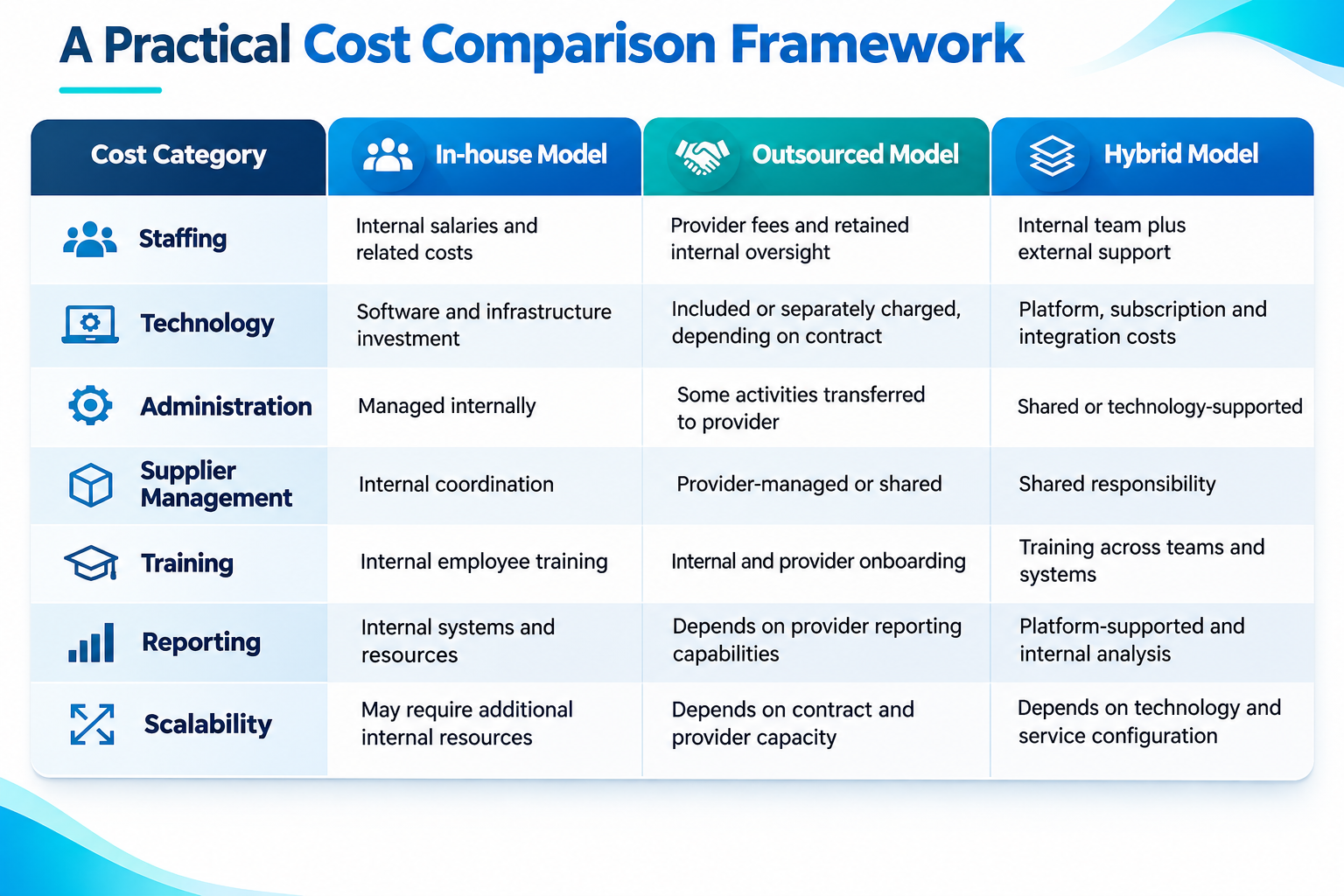
 

Practical Cost Comparison Framework


This comparison highlights an important point: the lowest visible operating cost does not necessarily represent the lowest total cost.

For example, an organisation may avoid external TMC fees by managing travel internally, but the additional administrative workload and technology requirements may reduce the financial advantage.

Similarly, outsourcing may reduce internal workload, but service fees and contractual charges must be evaluated against the actual services delivered.

Financial Metrics Worth Tracking

In addition to total cost, organisations should monitor operational indicators that influence the economics of their travel programme.

Cost per booking

Measures the average cost associated with processing a travel booking.

Cost per trip

Provides a broader view of the cost of managing each business trip, including relevant administrative and service expenses.

Administrative hours per booking

Helps identify the amount of employee time required to process travel requests and reservations.

Out-of-policy booking rate

Measures the proportion of bookings that fall outside established corporate travel guidelines.

Booking lead time

Shows how far in advance employees typically make travel arrangements and can help identify opportunities for better planning.

Technology cost per employee

Helps assess the investment required to support the organisation’s travel management infrastructure.

Travel spend visibility

Evaluates how effectively management can access consolidated information about travel expenditure.

Together, these indicators provide a more complete understanding of financial performance than booking costs alone.


5. In-House vs Outsourced vs Hybrid: Which Model Makes Financial Sense?

There is no universal answer. The most appropriate model depends on the organisation’s travel volume, operational complexity, internal capabilities and long-term business objectives.

When In-House Management May Be Appropriate

An in-house approach may be suitable for organisations that:

  • Have relatively straightforward travel requirements.

  • Maintain an experienced internal administration or travel team.

  • Prefer direct control over supplier relationships and processes.

  • Have existing systems that adequately support their requirements.

  • Can manage operational workloads without significant additional resources.

However, businesses should periodically review whether internal processes remain efficient as travel activity increases.

When Outsourcing May Be Appropriate

An outsourced model may be worth considering when organisations:

  • Require specialist travel management support.

  • Have complex booking and traveller service requirements.

  • Need additional operational capacity.

  • Want to reduce the internal workload associated with travel coordination.

  • Require access to external service capabilities.

The decision should include an assessment of contractual transparency, service levels, reporting access, technology capabilities and the provider’s ability to support the organisation’s requirements.

When a Hybrid Model May Be Appropriate

A hybrid approach may be suitable for businesses that want to retain strategic control while improving operational efficiency.

It can be particularly relevant when:

  • Travel volumes are increasing.

  • Multiple departments are involved in travel approvals.

  • The organisation operates across several locations.

  • Internal teams want better technology support.

  • Certain travel services require external expertise.

  • Management needs more consolidated reporting and visibility.

For these organisations, technology can become the connecting layer between internal teams, employees and external service providers.

The key is to establish clear ownership of responsibilities rather than allowing processes to become divided across disconnected systems.

6. The Role of Corporate Travel Technology in Changing the Economics

Corporate travel technology is changing how organisations approach the traditional in-house-versus-outsourced decision.

Businesses no longer need to choose between maintaining every process manually and transferring the entire operation to an external provider.

A centralised corporate travel management platform can support internal teams by bringing important travel activities into a more structured environment.

Centralised Booking Management

A centralised booking process can help organisations improve visibility into employee travel activity.

Rather than relying entirely on disconnected booking channels, businesses can work towards a more consistent booking environment.

Structured Approval Workflows

Travel approval processes can become difficult to coordinate when requests are managed through lengthy email conversations.

Digital approval workflows can help standardise how travel requests are submitted, reviewed and authorised.

This supports better process consistency and reduces dependence on manual follow-ups.

Travel Policy Management

Corporate travel policies need to be reflected in everyday booking and approval processes.

Technology-supported policy management can help organisations establish consistent rules and improve oversight of travel decisions.

Consolidated Reporting and Visibility

Management teams need reliable information to understand travel activity and expenditure.

Centralised reporting can help businesses review booking information, monitor travel patterns and make more informed operational decisions.

Improved Operational Coordination

When booking, approval and management activities are connected, internal teams can work with a more consistent set of information.

This can support better coordination between employees, administrators, finance teams and travel managers.

Ultimately, the objective is not simply to digitise existing processes. It is to improve the way corporate travel is managed across the organisation.

7. How OBT7 Supports a More Efficient Corporate Travel Management Approach

The economics of corporate travel management increasingly depend on how effectively organisations connect their people, processes and technology.

OBT7 is designed to support businesses looking for a more structured approach to corporate travel management.

Through its corporate travel management capabilities, OBT7 brings important travel activities into a connected platform environment.

Organisations can use capabilities such as:

  • Integrated booking engine: Supports a centralised environment for corporate travel bookings.

  • Travel policy compliance: Helps organisations align travel activity with established booking guidelines.

  • Approval and policy workflows: Supports more structured travel request and approval processes.

  • Advanced analytics: Helps management teams gain better visibility into travel activity and relevant performance information.

  • AI-powered recommendations: Supports more informed travel-related decisions.

  • Travel risk management: Contributes to a more structured approach to managing business travel requirements.

  • 24/7 support: Provides an additional support capability for corporate travel operations.

For organisations managing travel internally, a platform such as OBT7 can support more consistent processes and reduce reliance on fragmented manual coordination.

For businesses working with external travel providers, technology can also form part of a broader operating model that connects internal oversight with external services.

The objective is to help organisations improve operational visibility, streamline processes and manage corporate travel more effectively.

Rather than treating technology as an additional expense, businesses should evaluate how it contributes to the overall efficiency and financial performance of their travel programme.

8. A Practical Framework for Choosing the Right Operating Model

Before changing an existing corporate travel management structure, decision-makers should evaluate the following areas.

  1. Travel volume and complexity

How many bookings does the organisation process? How frequently do employees travel? Are trips domestic, international or spread across multiple countries?

  1. Internal capabilities

Does the organisation have the people, expertise and time required to manage travel efficiently?

  1. Current operational costs

What are the actual staffing, administration, technology and supplier-related costs?

  1. Technology readiness

Are existing booking, approval and reporting processes connected, or does the organisation rely on multiple disconnected systems?

  1. Management visibility

Can decision-makers access consolidated information about bookings, expenditure and policy compliance?

  1. Future scalability

Can the existing model support business expansion without creating disproportionate administrative complexity?

  1. Service and support requirements

Does the organisation require dedicated travel support, specialist services or external operational assistance?

  1. Financial return

Will the proposed operating model improve measurable outcomes relative to its total implementation and operating costs?

A structured assessment of these areas can help businesses select a model based on actual requirements rather than assumptions about which approach is inherently cheaper.

The Future of Corporate Travel Management Is About Measurable Value

The debate between in-house and outsourced corporate travel management is no longer simply about choosing between internal employees and external service providers.

It is about identifying the right combination of people, processes, technology and operational support.

An in-house model may offer direct control. Outsourcing can provide specialist capabilities and additional operational capacity. A hybrid approach can combine internal oversight with external services and technology.

However, the financial effectiveness of each model depends on how well it manages the total cost of travel operations.

For modern organisations, the opportunity lies in moving beyond fragmented processes, improving management visibility and using technology to make corporate travel operations more efficient.

With the right approach, businesses can make more informed decisions about travel expenditure, operational resources and long-term scalability.

Looking to make corporate travel management more efficient?

Discover how OBT7 can help your organisation centralise travel operations, streamline approval workflows and improve visibility across corporate travel activities.

Book a personalised demo with OBT7 and explore a smarter approach to corporate travel management.

Frequently Asked Questions

Neither model is universally more cost-effective. In-house management involves staffing, technology and administrative expenses, while outsourcing introduces provider fees and contractual costs. Businesses should compare the total cost of ownership, service requirements and operational efficiency before making a decision.
Common hidden costs include employee time spent coordinating bookings, manual approval processes, fragmented booking channels, technology maintenance, training and limited reporting visibility. These costs can increase as travel activity becomes more complex.
TMC fees form part of the outsourced travel management cost structure. Depending on the agreement, charges may include transaction fees, management fees, service charges and additional support costs. Businesses should evaluate these against the scope and quality of services provided.
A company may consider outsourcing when its travel requirements become difficult to manage internally, when specialist support is required or when the administrative workload places pressure on internal resources. The decision should be based on a comparison of total costs, service needs and operational capabilities.
A hybrid model combines internal travel management responsibilities with external services and technology. Internal teams may retain control over budgets and policies, while external providers and digital platforms support bookings, approvals, reporting and operational coordination.
Corporate travel software can support more structured booking, approval and policy management processes. By centralising relevant activities, it can reduce dependence on disconnected tools and repetitive manual coordination. The actual impact depends on implementation, platform capabilities and employee adoption.
CFOs should compare the total cost of implementing and operating the software against measurable improvements. These may include reduced administrative hours, improved policy compliance, better expenditure visibility and more efficient booking processes. Any claimed financial savings should be supported by baseline measurements and post-implementation data.
Companies can maintain control by defining clear travel policies, establishing contractual service levels, setting reporting requirements, retaining budget ownership and regularly reviewing provider performance. Technology-enabled visibility can also support more consistent oversight.

Make corporate travel management more efficient with OBT7.

Explore OBT7 | Book a Demo

obt7 logo

Ready To Get Started

Subscribe To Our Newsletter

obt7 pci dss