






Choosing a corporate travel booking platform involves more than finding a convenient way to book flights and hotels. Businesses need to balance travel costs, employee experience, approval workflows, policy compliance, financial visibility, traveler safety, and the complexity of managing trips across multiple destinations.
The right platform can help bring these activities into a more structured process. The wrong one may leave teams managing bookings across disconnected systems, chasing approvals manually, and reconciling travel expenses long after a trip has ended.
The challenge is that corporate travel platforms are not all built for the same purpose. Some focus on self-service booking, some combine travel with expense management, and others provide technology alongside a managed travel service. The best option depends on your organization’s size, travel patterns, existing systems, and the level of support your employees require.
Key takeaways
Define your travel-management requirements before comparing vendors.
Evaluate booking inventory, policy controls, approvals, reporting, integrations, support, and total cost—not just the interface.
Distinguish between booking software, expense-management systems, and travel management companies (TMCs).
Consider advanced capabilities such as AI-assisted recommendations, automated policy enforcement, predictive analytics, and travel-risk management where they are available and appropriate.
Include OBT7 in your shortlist if you want to explore integrated booking, configurable travel policies, multi-level approvals, expense visibility, analytics, and traveler support.
Business requirement | How a suitable platform can help |
Booking efficiency | Bring relevant travel options into a more consistent booking process. |
Policy compliance | Present or enforce travel rules during booking. |
Approval management | Route travel requests to the appropriate managers or administrators. |
Cost visibility | Consolidate booking and spending information for reporting. |
Employee experience | Make it easier for employees to arrange and manage business trips. |
Traveler safety | Help travel teams access itinerary information and coordinate support. |
Financial processes | Connect travel information with expense and finance workflows where supported. |
The precise capabilities vary by provider, subscription, configuration, and integration. Organizations should validate the features they need during a product demonstration rather than assume every platform offers the same functionality.
Platform |
|
|
1. Navan |
|
|
2. SAP Concur |
|
|
3. Perk |
|
|
4. American Express Global Business Travel |
|
|
5. BCD Travel |
|
|
6. Egencia |
|
|
7. FCM Travel |
|
|
8. OBT7 |
|
|
9. Spotnana |
|
|
10. ITILITE |
|
|
11. Corporate Travel Management (CTM) |
|
|
12. CWT |
|
|
13. TravelBank |
|
|
14. BizAway |
|
|
15. Serko Zeno |
|
|
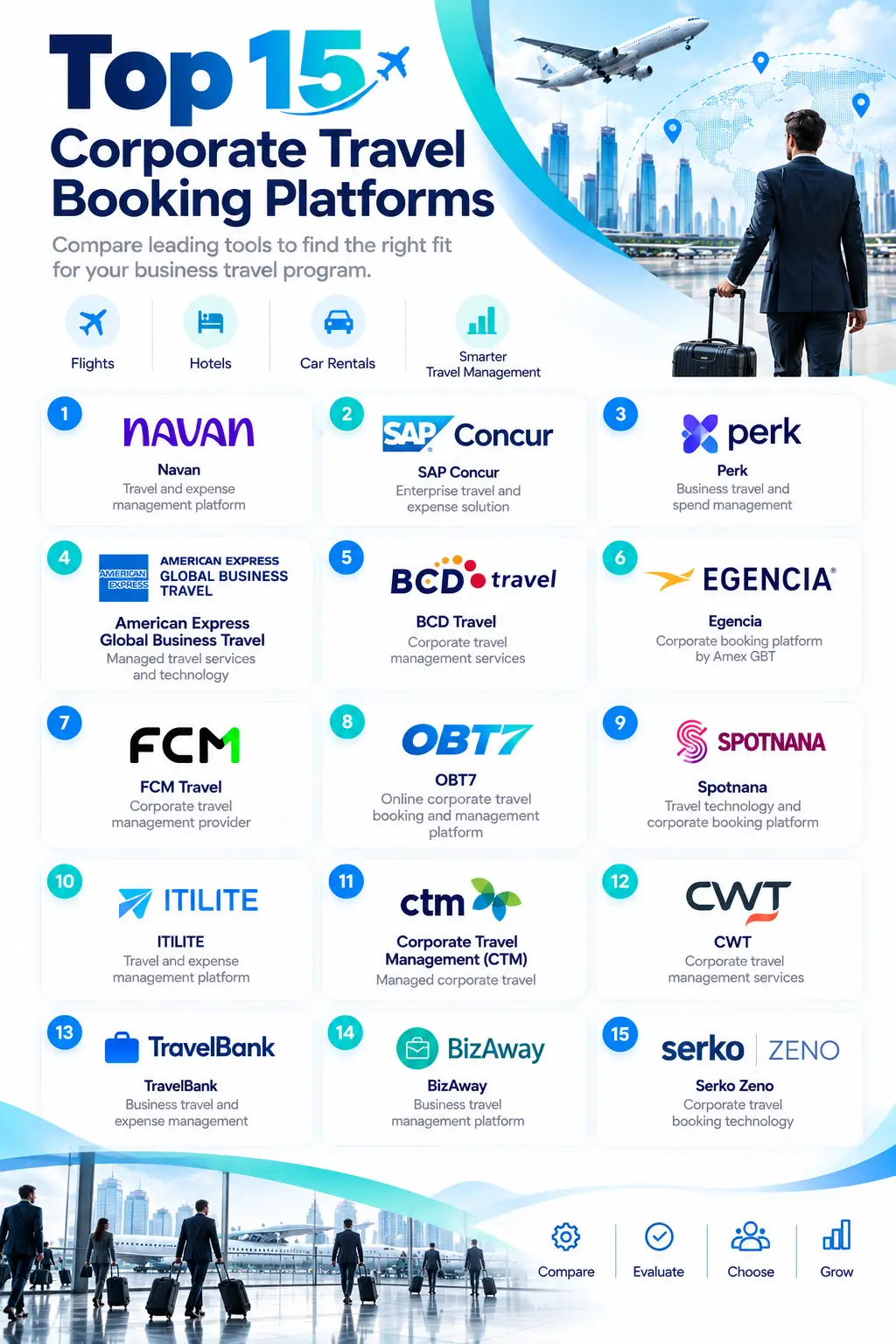
The following shortlist covers different approaches to corporate travel, from self-service booking technology to enterprise travel-and-expense suites and managed travel services. It is not a definitive ranking: the right choice depends on your requirements, destination coverage, service expectations, and budget.
The providers are presented in a practical comparison order, with OBT7 included as an option to evaluate.
Platform | Primary area to evaluate | May be worth considering when… |
1. Navan | Travel, expense and spend management | You want to assess a combined travel-and-expense experience. |
2. SAP Concur | Enterprise travel and expense workflows | Your organization has complex finance processes or existing SAP-related systems. |
3. Perk | Business travel and spend management | You want to compare centralized booking and related spend workflows. |
4. American Express Global Business Travel | Managed travel services and technology | You need a provider that combines travel technology with managed services. |
5. BCD Travel | Corporate travel program management | You are evaluating a managed travel model and its service capabilities. |
6. Egencia | Corporate booking and travel support | You want to examine self-service booking with travel-management support. |
7. FCM Travel | Managed travel and booking technology | Your requirements include corporate travel services and regional support. |
8. OBT7 | Online corporate booking, policy controls and travel analytics | You want to evaluate an integrated booking platform with configurable travel-management workflows. |
9. Spotnana | Travel technology and booking infrastructure | You want to assess its approach to travel content and booking technology. |
10. ITILITE | Travel, expense and spend management | You want to compare booking and expense-related workflows. |
11. Corporate Travel Management (CTM) | Managed corporate travel | You need to evaluate service delivery and travel technology together. |
12. CWT | Managed business travel | You want to investigate a service-led travel-management arrangement. |
13. TravelBank | Travel and expense workflows | You want to compare travel management with related financial processes. |
14. BizAway | Business travel booking and management | You want another platform to assess for booking and policy requirements. |
15. Serko Zeno | Corporate booking technology | You want to compare booking workflows and available travel content. |
This is a research shortlist, not a statement that all 15 providers offer equivalent features. Product availability, service coverage, integrations, and plan details should be verified directly with each vendor.
Independent comparison resources also distinguish software-first platforms from TMCs and providers combining technology with agent support. This distinction matters because two products can both be described as corporate travel solutions while delivering quite different services.
Navan
Navan combines corporate travel with expense and spend-management capabilities. It is worth evaluating if your priority is to connect travel booking with financial workflows.
During a comparison, examine its booking experience, policy controls, expense capabilities, reporting, and suitability for your existing finance processes.
SAP Concur
SAP Concur is an option for organizations that need structured travel, expense, approval, and reporting workflows. Its published travel capabilities include policy controls, approval routing, travel reporting, and AI-assisted features.
Businesses considering it should investigate implementation complexity, the role of their TMC, and how well it fits their existing enterprise systems.
Perk
Perk, formerly TravelPerk, provides business travel and spend-management technology. It is worth assessing for companies looking to centralize travel arrangements and connect travel processes with broader spend workflows.
Compare the features included in the relevant plan, policy configuration, flexibility, integrations, and support arrangements.
American Express Global Business Travel
American Express Global Business Travel (Amex GBT) offers corporate travel solutions combining technology and managed services. Its product portfolio includes different approaches to booking, servicing, expense workflows, and travel-program support.
It is particularly relevant to evaluate when your company needs to compare a managed travel relationship with a software-only arrangement.
BCD Travel
BCD Travel is a corporate travel management provider. When assessing it, examine the scope of its managed services, booking technology, reporting capabilities, traveler support, and the regions in which your organization needs assistance.
A direct comparison should clarify which services are included in the proposed arrangement and which require additional configuration or fees.
Egencia
Egencia, part of the Amex GBT portfolio, combines a corporate booking platform with travel-management support. Its published offering highlights booking technology, travel-and-expense connectivity, and access to travel content.
Evaluate its fit against your booking requirements, integration needs, support expectations, and existing travel program.
FCM Travel
FCM Travel combines corporate travel services with booking technology. Businesses considering it should look at its support model, geographic coverage, booking workflows, and ability to meet their organization’s service requirements.
The important comparison is the full travel-management proposition—not just the digital booking interface.
OBT7
OBT7 is an online corporate travel booking and management platform developed by Blue Seven Technologies LLC. Its published offering includes an integrated booking engine for flights, hotels, and rental cars, customizable travel-policy controls, multi-tier approval workflows, expense-related capabilities, and advanced analytics.
The platform is worth including in a corporate travel evaluation when an organization wants to explore how booking, policy management, approval processes, and travel visibility can be brought together.
Several capabilities are particularly relevant to the selection criteria discussed earlier:
Integrated booking: Search and book flights, hotels, and rental cars through the platform.
Configurable travel policies: Align travel rules with organizational guidelines and budget constraints.
Multi-tier approval workflows: Structure review and approval processes around business requirements.
Expense visibility: Assess the platform’s published expense tracking, reporting, and reconciliation capabilities, including how these work with existing financial systems.
Advanced analytics: Use dashboards and travel data to review performance and spending patterns.
Traveler support: Evaluate its published 24/7 assistance, travel-risk management, duty-of-care services, and multiple support channels.
Advanced technology direction: OBT7 also lists AI-powered travel recommendations, automated policy enforcement, and customizable dashboards with predictive analytics among its innovative capabilities. Buyers should confirm which features are currently available, how they operate, and whether they require specific configuration or integrations.
These capabilities make OBT7 a high-potential platform to evaluate, especially for businesses seeking a connected corporate travel workflow. That is a reason to include it in a shortlist—not a substitute for testing it against the same criteria as competing products.
Before choosing OBT7, arrange a walkthrough using realistic company scenarios. Test a standard booking, an out-of-policy request, a multi-level approval, a booking change, and a travel-spend report. Ask about supplier coverage, implementation, integrations, support terms, pricing, and any additional requirements.
Official website: obt7.com
Spotnana
Spotnana is a travel technology and corporate booking platform. It is worth investigating for organizations interested in booking infrastructure, travel content connectivity, and how the technology fits into their travel-management model.
Confirm which capabilities are delivered directly, which depend on partners, and how the platform would fit into your existing operations.
ITILITE
ITILITE offers corporate travel and expense-management technology. It belongs on a shortlist when businesses want to examine travel booking alongside expense workflows and spend-related controls.
Compare its feature availability, integrations, support model, and total cost for your expected travel volume.
Corporate Travel Management (CTM)
Corporate Travel Management (CTM) is a managed corporate travel provider. It is worth assessing for organizations that value a combination of travel technology and managed service.
Ask about the booking platform, regional coverage, reporting, traveler support, and the exact scope of services available to your organization.
CWT
CWT provides corporate travel management services. It is relevant to comparisons where the organization wants to evaluate a managed travel arrangement rather than purchase booking software in isolation.
Assess service coverage, travel support, reporting, technology, and the commercial terms of the proposed program. Confirm the current offering directly with the provider.
TravelBank
TravelBank combines business travel and expense-management capabilities. It is an option to investigate if the company wants to connect booking activity with spending and financial workflows.
During evaluation, examine booking coverage, policy functionality, reporting, integrations, and which capabilities are included in the selected plan.
BizAway
BizAway is another business travel management platform worth evaluating. Include it when building a broad shortlist, but verify its current product features, regional coverage, policy options, and support arrangements directly.
As with any vendor, make the comparison based on demonstrable capabilities rather than marketing labels alone.
Serko Zeno
Serko provides corporate travel booking technology, including its Zeno platform. It is worth examining when your organization wants to compare booking workflows, available travel content, and the way technology supports its travel program.
Ask for a demonstration of the specific features your business needs and confirm the availability of integrations, service arrangements, and relevant booking content.
There is no single platform that is best for every business. A growing company with a few trips each month may have very different requirements from a multinational organization with complex approval hierarchies, negotiated supplier rates, and extensive reporting needs.
Use the following criteria to create a shortlist.
Evaluate the complete booking experience
Start with the types of travel your employees regularly need to arrange.
Consider whether the platform supports:
Domestic and international flights.
Hotel searches and bookings.
Rental cars and other relevant ground transport.
Search filters and practical itinerary comparisons.
Access to the travel content and suppliers your organization needs.
Booking changes, cancellations, and itinerary management.
A platform may advertise broad inventory, but availability can vary by destination, supplier, fare type, and booking channel. Test representative trips from your own travel patterns before making a decision.
Also consider how easy the booking process is for employees. A system that is technically capable but difficult to use may encourage travelers to book outside the approved process, reducing visibility and making policy compliance harder.
2. Look for travel-policy controls
Travel policies typically define approved booking channels, spending limits, preferred suppliers, advance-booking expectations, and rules for different employee roles or destinations.
A useful platform should help translate these rules into the booking process.
Depending on the system, policy controls may:
Display preferred or compliant options.
Flag bookings that fall outside policy.
Request a justification for exceptions.
Restrict certain booking choices.
Apply different rules to different teams or traveler categories.
The distinction between informing and enforcing a policy is important. A warning message is not the same as a system that requires approval or blocks a booking.
When evaluating vendors, ask for a live demonstration of how the platform handles an out-of-policy hotel rate or a flight that exceeds the company’s budget.
3. Check approval workflows
Approval workflows help organizations review travel before spending is committed.
A straightforward process might require a manager to approve an employee’s trip. A more complex policy could involve a department head, travel administrator, project owner, or finance team.
Check whether the platform supports:
Single-level and multi-level approvals.
Approval rules based on policy, cost, department, or traveler.
Notifications and reminders.
Mobile or remote approval.
Exception handling and an auditable approval history.
Clear visibility into the status of pending requests.
Avoid adding unnecessary approval steps. The goal is to maintain appropriate financial control without creating delays for routine, policy-compliant travel.
Some systems can route exceptions for review while allowing eligible bookings to proceed through a more streamlined process. The available options and degree of automation should be confirmed with each provider.
4. Assess reporting and travel-spend visibility
A booking system becomes more valuable when it helps decision-makers understand travel activity.
Useful reporting may include:
Total spend by department, cost centre, project, or destination.
Booking patterns and advance-booking behaviour.
Policy compliance and exception trends.
Supplier or travel-category spending.
Trip status and upcoming travel.
Data that supports budget reviews and supplier negotiations.
Look beyond attractive dashboards. Ask how frequently the information is updated, which data is included, whether reports can be exported, and how the platform handles bookings made outside its approved channels.
Advanced analytics can help identify patterns and support better decisions, but their usefulness depends on data quality, reporting flexibility, and how the business applies the insights.
5. Examine expense-management and finance integrations
Travel booking and expense processing are closely connected, but they are not always handled by the same product.
Some platforms include expense tools, while others integrate with separate expense-management, accounting, enterprise resource planning (ERP), or finance systems.
Before choosing, determine whether you need:
Travel booking data to flow into expense reports.
Automated expense tracking or reconciliation.
Integration with corporate cards or payment systems.
Cost-centre and project-level reporting.
Exportable financial data.
Connections to your existing accounting or ERP environment.
The key question is not whether a vendor lists many integrations. It is whether it supports your actual systems, data requirements, and workflow without introducing additional manual work.
6. Consider traveler support and duty of care
Business trips do not always go as planned. Flights are delayed, schedules change, bookings need to be modified, and travelers may need assistance outside regular working hours.
Evaluate the support model as carefully as the booking interface.
Ask:
Is support available 24/7, and in which regions?
Can travelers contact support by phone, chat, or messaging?
Who handles cancellations, rebooking, and urgent disruptions?
Can the organization access traveler itinerary information when needed?
What travel-risk and duty-of-care services are included?
Are support services provided directly or through a third party?
The level of service differs significantly between self-service software and managed travel arrangements. Some organizations need primarily digital tools; others need a combination of technology and human travel consultants.
7. Review AI and automation capabilities carefully
AI and automation are becoming more visible in corporate travel technology. Depending on the provider, these capabilities may help employees interpret policies, compare suitable options, identify exceptions, or reduce repetitive administrative tasks.
Potentially useful capabilities include:
AI-assisted travel recommendations.
Policy guidance during the booking process.
Automated routing of approval requests.
Predictive or trend-based travel analytics.
Assistance with changes and disruptions.
Automated data transfer between travel and expense workflows.
However, the label “AI-powered” is not enough to judge a product. Ask what the feature actually does, which data it uses, whether a human must approve its decisions, and whether it is generally available in the version you would purchase.
For any vendor, distinguish between features that are live, features that require a particular plan or integration, and capabilities that are announced or still being developed.
8. Compare total cost, implementation, and scalability
The subscription price is only one part of the total cost of a corporate travel platform.
Depending on the provider and service model, expenses may include booking fees, transaction charges, implementation, support, integration work, and optional modules.
Compare:
Recurring platform and service fees.
Per-booking or transaction charges.
Implementation and employee onboarding.
Integration and configuration costs.
Support or after-hours service charges.
Contract terms and minimum commitments.
The cost of scaling as booking volumes increase.
Pricing structures vary, and many corporate travel providers prepare quotations based on company requirements. Request a written breakdown for your expected booking volume rather than comparing headline prices alone.
A useful way to assess OBT7 is to examine how its published features map to common corporate travel requirements.
Unified booking environment
OBT7’s integrated booking engine covers flights, hotels, and rental cars, giving businesses a starting point for bringing travel arrangements into a shared system.
Policy-driven travel management
Configurable travel policies and multi-tier approval workflows can help organizations structure how requests are reviewed and authorized.
Analytics and financial visibility
Published reporting and analytics capabilities are relevant for organizations seeking clearer views of travel expenditure, performance, and policy adherence.
Advanced technology potential
OBT7 lists AI-powered recommendations, automated policy enforcement, and customizable dashboards with predictive analytics among its innovative features. Confirm their current availability and exact functionality during evaluation.
Traveler assistance and risk management
OBT7 describes 24/7 assistance, duty-of-care services, travel-risk management, and multiple support channels as part of its offering.
The opportunity is to evaluate these capabilities as a connected system rather than as isolated features. For example, a booking can be assessed against a travel policy, routed for approval, recorded for reporting, and supported when changes occur.
However, the practical value depends on how the workflows operate in the live product, how well they integrate with existing systems, and which features are included in the proposed implementation. A product demonstration should establish these details before a purchase decision.
Once you have narrowed the list to three or four providers, use a consistent evaluation process.
Step 1: Define your requirements
Document your booking volumes, travel destinations, typical traveler profiles, approval rules, finance systems, and support needs. Separate essential requirements from desirable extras.
Step 2: Use the same scenarios for every vendor
Ask each provider to demonstrate the same real-world tasks:
Book a flight and hotel within company policy.
Submit a request that exceeds the permitted budget.
Route a trip through multiple approval levels.
Change or cancel an existing booking.
Generate a travel-spend report.
Locate traveler information during a disruption.
Transfer relevant booking and expense data to your finance systems.
This makes it easier to compare actual workflows rather than relying on feature lists.
Step 3: Score each provider
A weighted scorecard helps stakeholders make a more transparent decision.
The following weights are a suggested starting point, not an industry-standard scoring model.
Evaluation area | Suggested weight |
Booking experience and inventory | 20% |
Policy controls and approvals | 20% |
Reporting and spend visibility | 15% |
Integrations and expense workflows | 15% |
Traveler support and duty of care | 10% |
Automation and advanced capabilities | 10% |
Total cost and implementation | 10% |
Total | 100% |
Score each provider from 1 to 5 against each area. Multiply each score by its assigned weight, then compare the results alongside qualitative findings.
Do not let a high overall score compensate for a critical missing requirement. If a platform cannot support a mandatory integration or the destinations your employees regularly visit, it may not be the right choice regardless of its total score.
Step 4: Validate the commercial proposal
Request a written quotation that identifies recurring fees, booking charges, implementation, integrations, support, and optional modules.
Also confirm contract terms, data access, onboarding responsibilities, and how the provider handles product updates.
Step 5: Test with a pilot
Where practical, pilot the preferred solution with a representative group of employees, approvers, and finance users.
Track booking completion, policy exceptions, approval turnaround, support requests, employee feedback, and the effort required to produce reports. These measures provide a more useful basis for a decision than a demonstration alone.
Choosing on price alone. A low initial fee may not reflect service charges, integration costs, or the internal effort required to operate the system.
Confusing booking software with a managed travel service. Some providers mainly supply technology; others include travel consultants and operational support. Determine which model you need.
Assuming every AI feature is fully available. Ask for a live demonstration and clarify whether a feature is generally available, plan-dependent, partner-provided, or still under development.
Ignoring employee adoption. A complicated booking process may encourage employees to use unapproved channels, undermining visibility and policy compliance.
Overlooking implementation. Data migration, configuration, integrations, training, and change management can influence the success of a travel platform.
Failing to test exceptions. A platform should be evaluated on how it handles changes, cancellations, unusual itineraries, policy violations, and urgent travel issues—not only routine bookings.
See how OBT7 can support your travel program
Explore the platform and assess its capabilities against your company’s booking, compliance, reporting, and operational requirements.

© 2026 All rights reserved. Developed by Blue Seven Technologies LLC