






Negotiated corporate rates can significantly improve business travel costs—but securing a discount is only the first step. The real savings come when employees actually use those rates, stay within travel policy, and every booking can be tracked and measured.
For companies across the UAE and GCC, business travel can quickly become a significant operational expense. Flights between Dubai, Riyadh, Doha, Jeddah, Kuwait City, Muscat and other regional business hubs add up, while hotel stays, last-minute bookings and frequent itinerary changes create additional pressure on travel budgets.
That is why many businesses negotiate preferred rates with airlines, hotels and other travel suppliers.
But there is an important distinction:
Negotiated doesn’t always mean saved.
A company can negotiate an attractive hotel rate and still lose the expected savings if employees cannot find the rate, book outside preferred channels, bypass travel policies or make last-minute bookings without visibility.
This guide explains how negotiated corporate travel rates work in the GCC, how companies can negotiate better airline and hotel deals, and how technology can turn negotiated rates into measurable travel savings.
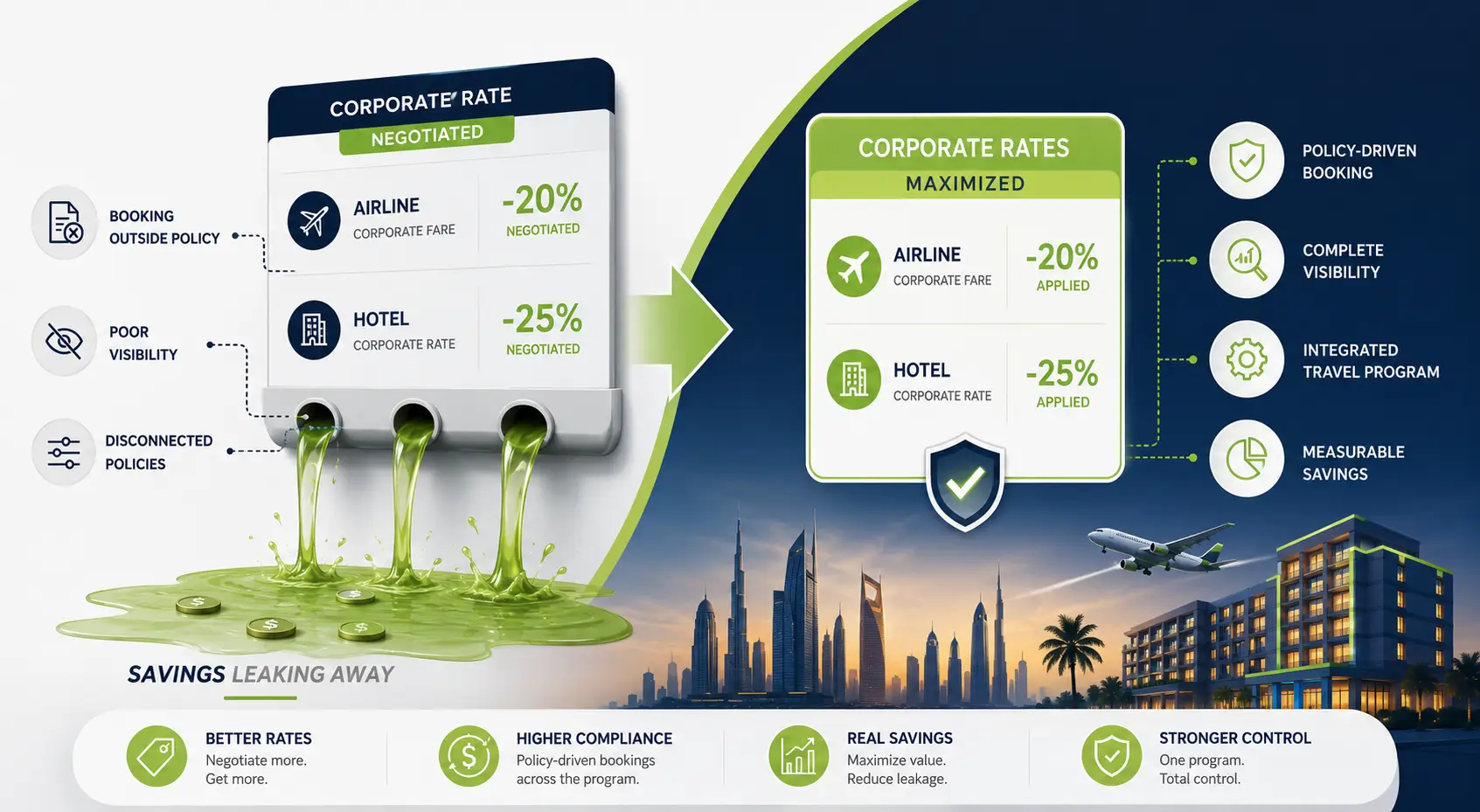
Negotiated corporate travel rates are special prices or commercial terms agreed between a business and a travel supplier based on the company’s expected travel activity.
These arrangements can apply to:
Airlines
Hotels
Car rental providers
Ground transportation companies
Travel management companies
Other travel suppliers
A negotiated agreement may provide a company with discounted pricing, preferred availability, flexible cancellation terms, additional amenities or other benefits.
The exact structure depends on the supplier, destination, travel volume, contract terms and relationship between the company and supplier.
For example, a company with significant travel between the UAE and Saudi Arabia may negotiate preferred arrangements with hotels in Riyadh, Jeddah and Dubai. A company with frequent travel on particular airline routes may also explore corporate airline agreements.
The objective isn’t simply to obtain the biggest headline discount.
It is to create consistent, measurable value across the company’s travel program.
The GCC is home to businesses with highly mobile workforces and strong regional and international connections.
Employees may regularly travel for:
Client meetings
Sales visits
Supplier negotiations
Conferences
Project deployments
Site visits
Regional management meetings
Training
Business development
Cross-border operations
For a company with dozens or hundreds of travelers, even relatively small differences in booking costs can accumulate over time.
Consider a company that regularly books hotels in several GCC cities.
If employees consistently use preferred properties and negotiated rates, procurement can gain greater control over travel spend.
But if employees book independently through different channels, the company may have little visibility into:
Which suppliers are being used
Whether negotiated rates are being utilized
How much is being spent by department
Where travel policy exceptions occur
How much is being spent outside preferred suppliers
This creates a gap between negotiated savings and realized savings.
This is one of the most important concepts for corporate travel procurement.
Imagine your company negotiates a preferred hotel rate of AED 500 per night.
The public rate is AED 600.
On paper, you’ve saved AED 100.
But what happens if an employee:
The negotiated rate exists.
But the company didn’t actually realize the saving.
This is why corporate travel optimization has to go beyond supplier negotiations.
The complete process looks more like:
Negotiate → Make Available → Guide → Book → Track → Measure
That’s where a corporate booking and travel management platform becomes important.
Hotels can be one of the most significant areas for corporate travel savings, particularly for companies with recurring stays in specific cities.
However, successful hotel negotiation requires more than simply asking for a discount.
Before approaching hotels, understand your existing travel patterns.
Analyze:
Number of room nights
Average nightly spend
Most frequently visited cities
Most frequently used properties
Peak travel periods
Average length of stay
Cancellation patterns
Department-level travel
Annual hotel spend
For example, if your employees collectively spend hundreds of room nights each year in Riyadh, that data provides a stronger basis for approaching preferred properties than simply asking for a corporate discount.
Your historical travel data is your negotiation leverage.
Don’t try to negotiate with every hotel in every city.
Start with the locations where your company has meaningful and recurring demand.
For a GCC-based organization, that could include:
Dubai
Abu Dhabi
Riyadh
Jeddah
Doha
Kuwait City
Muscat
Manama
The right destinations will depend entirely on your company’s travel patterns.
The goal is to concentrate negotiation efforts where they can produce the greatest impact.
Instead of giving employees an unlimited list of “preferred” hotels, create a manageable supplier strategy.
For each important destination, identify properties that meet your requirements for:
Location
Price
Quality
Business facilities
Traveler preferences
Cancellation flexibility
Safety requirements
Corporate needs
A focused preferred-supplier strategy can make procurement easier to manage and travel policy easier for employees to follow.
The cheapest room rate isn’t necessarily the best corporate deal.
Depending on the company’s requirements, negotiations can also consider:
Breakfast
Wi-Fi
Parking
Cancellation terms
Early check-in
Late checkout
Room upgrades
Flexible booking conditions
Meeting facilities
Other business-travel benefits
A slightly higher rate with better flexibility may ultimately provide greater value than a deeply discounted rate with restrictive conditions.
Corporate hotel programs can use different pricing approaches.
Fixed negotiated rate
A predetermined corporate price is agreed for a particular period.
Dynamic discount
The company receives a percentage discount against an applicable public or flexible rate.
Neither approach is automatically better.
The right model depends on:
Destination
Seasonality
Travel volume
Hotel demand
Rate volatility
Negotiated terms
Procurement teams should compare the actual expected cost, not just the advertised discount percentage.
Airline negotiations require a slightly different approach.
A company should first understand where its employees actually fly.
Analyze:
Most frequent routes
Most frequently used airlines
Annual airfare spend
Travel frequency
Cabin class
Peak travel periods
Domestic vs international travel
GCC vs long-haul travel
For example, a company that consistently travels between Dubai and Riyadh has a different negotiation opportunity from a company whose employees fly to dozens of destinations with no clear concentration.
Focus on travel patterns—not assumptions.
Your supplier strategy should reflect where your business actually travels.
The lowest fare isn’t necessarily the best corporate arrangement.
Depending on the company’s needs, businesses may consider:
Competitive corporate pricing
Fare flexibility
Change conditions
Cancellation terms
Baggage allowances
Upgrade options
Frequent-flyer considerations
Route availability
Traveler convenience
For organizations with frequent last-minute travel, flexibility can sometimes be more valuable than a small reduction in the initial ticket price.
The objective should be to optimize total travel value, not simply chase the lowest fare.
Negotiating rates is only the beginning.
Here are seven ways companies can turn negotiated rates into actual savings.
1. Consolidate Travel Spend
If travel is fragmented across multiple booking channels and suppliers, procurement may struggle to understand total demand.
Centralizing travel data gives procurement a clearer picture of where money is going.
2. Use Historical Travel Data
Don’t negotiate based on assumptions.
Use actual:
Spend
Routes
Room nights
Destinations
Suppliers
Booking frequency
This helps procurement identify where negotiation efforts can have the greatest impact.
3. Establish Preferred Suppliers
Create a clear list of preferred airlines, hotels and other suppliers based on business requirements.
This makes it easier for employees to make compliant choices.
4. Make Negotiated Rates Easy to Find
A negotiated rate that employees cannot find is unlikely to generate savings.
Preferred rates should appear naturally during the booking process.
The employee shouldn’t need to:
Search an email → find a rate code → visit another website → compare options → contact someone → complete the booking.
The booking experience should make the preferred option obvious.
5. Automate Travel Policy Controls
Travel policy shouldn’t exist only as a document employees are expected to remember.
It should become part of the booking process.
For example, the system can help guide employees toward:
Preferred suppliers
Approved fare classes
Approved hotel categories
Spending limits
Approval requirements
This makes compliance part of the workflow rather than an after-the-fact check.
6. Track Supplier Adoption
Procurement should regularly ask:
Are employees actually using our negotiated suppliers?
Track metrics such as:
Preferred supplier usage
Out-of-policy bookings
Booking channel usage
Average travel spend
Supplier share
Policy compliance
Rate utilization
A negotiated supplier agreement without adoption is a missed opportunity.
7. Measure Realized Savings
The ultimate question isn’t:
“How much did we negotiate?”
It’s:
“How much did the business actually save?”
That distinction is critical.
A strong corporate travel program should connect supplier agreements with actual booking behavior and spend data.
There is a common assumption that once a corporate rate has been negotiated, the job is done.
It isn’t.
The real challenge is execution.
Think of the process as a chain:
Supplier Negotiation
↓
Preferred Rate
↓
Employee Booking
↓
Policy Compliance
↓
Supplier Adoption
↓
Spend Visibility
↓
Measured Savings
If any part of that chain breaks, the expected value of the negotiated agreement can disappear.
For example:
Negotiated rate → employee books elsewhere → saving lost
Or:
Preferred supplier → employee exceeds policy → approval delay → last-minute booking → higher cost
The technology supporting the booking process therefore matters just as much as the negotiation itself.
An Online Booking Tool (OBT) gives employees a centralized environment to search and book business travel while allowing companies to apply policies, approvals and controls around the process.
Instead of relying on disconnected:
Emails
Spreadsheets
Travel requests
Supplier websites
Manual approvals
Booking confirmations
companies can centralize the travel journey.
For negotiated corporate rates, this creates an important advantage:
The rate can be presented at the moment the employee is making the booking decision.
That changes the question from:
“Did we negotiate a discount?”
to:
“Did the employee actually book using the negotiated rate?”
That’s a much more useful question for procurement.
OBT7 brings the corporate travel process into one centralized platform.
For businesses managing travel across the UAE and wider GCC, this can help connect booking, policy, approvals and visibility.
Centralized corporate booking
Employees can manage business travel through a single corporate booking environment rather than relying on scattered booking channels.
Policy controls
Companies can establish travel rules that help guide employees toward compliant options.
Automated approvals
Approval workflows can be configured according to company requirements, reducing unnecessary manual follow-ups.
Preferred travel options
Companies can structure their travel program around preferred suppliers and approved travel choices.
Real-time visibility
Travel teams and management can gain greater visibility into bookings and travel activity.
Reporting and analytics
Centralized travel information can help companies understand travel spend, supplier usage and booking behavior.
The important point is that OBT7 doesn’t replace the negotiation process.
It helps companies operationalize it.
Negotiate better rates. Make them accessible. Guide employees toward them. Then measure what actually happens.
That’s how negotiated rates can become measurable travel savings.
Imagine a UAE-based company regularly sending employees to Riyadh.
The procurement team identifies a hotel with significant room-night volume and negotiates a preferred corporate rate.
Without centralized travel management
The employee receives an email about the preferred hotel.
But when the trip comes up, they:
Search online
Compare several properties
Book through another channel
Forget the negotiated rate
The procurement team has no immediate way to understand why the preferred rate wasn’t used.
With a centralized booking process
The employee searches for accommodation.
↓
Preferred options are surfaced.
↓
Travel policy is applied.
↓
Approval is routed automatically if required.
↓
The employee books.
↓
The booking is captured centrally.
↓
Procurement can analyze supplier usage and spend.
The difference isn’t simply the negotiated rate.
It’s the ability to operationalize the rate.
1. Negotiating Without Data
If procurement doesn’t understand travel volume and patterns, it becomes difficult to determine where the greatest opportunities exist.
2. Chasing the Biggest Discount
A 15% discount isn’t automatically better than a 10% discount if the underlying rate, restrictions or availability make the deal less valuable.
3. Having Too Many Preferred Suppliers
An overly complicated supplier list can confuse employees and make compliance harder.
4. Keeping Negotiated Rates in Spreadsheets
If employees need to search through documents or emails to find corporate rates, adoption can suffer.
5. Ignoring Off-Channel Booking
A negotiated rate doesn’t help if employees regularly book elsewhere.
6. Measuring Negotiation Instead of Adoption
Procurement should measure realized savings and supplier usage, not simply the discount written into the contract.
A corporate travel program should be measured using more than total travel spend.
Consider tracking:
Preferred supplier adoption
What percentage of eligible bookings use preferred suppliers?
Policy compliance
How often do employees book within policy?
Negotiated-rate utilization
How frequently are negotiated rates actually used?
Average booking cost
How does actual booking cost compare over time?
Advance purchase behavior
How far in advance are flights and hotels being booked?
Out-of-policy spend
How much travel spend occurs outside established rules?
Supplier concentration
Are negotiated suppliers receiving the expected booking volume?
Realized savings
How much measurable value is generated from the travel program?
These metrics help procurement move from “We negotiated a good deal” to “We can prove the program is delivering value.”
Corporate travel procurement is moving beyond simply negotiating discounts.
The more mature approach connects:
Procurement + Technology + Policy + Data
Procurement negotiates the supplier relationship.
Technology makes the preferred options accessible.
Travel policy guides employee decisions.
Analytics show whether the strategy is working.
This creates a continuous improvement cycle:
Analyze → Negotiate → Implement → Monitor → Optimize
For growing GCC businesses, this approach can provide a stronger foundation for managing travel costs as the number of employees, destinations and business trips increases.
A negotiated corporate rate can look impressive on paper.
But the real value comes when employees can easily access it, company policies guide the booking, approvals happen efficiently and procurement can measure the outcome.
That’s why the most effective corporate travel strategy isn’t simply:
“Get a better rate.”
It’s:
“Get the right rate, make it easy to use, and make the savings measurable.”
For GCC businesses, that means connecting supplier negotiations with the technology employees actually use to book business travel.
Negotiated rates create the opportunity.
Good travel management turns that opportunity into savings.
OBT7 helps businesses centralize corporate travel booking, automate approvals, enforce travel policies and gain greater visibility into travel activity—all from one platform.
If your company is negotiating corporate rates but still managing bookings through emails, spreadsheets and disconnected channels, it may be time to rethink the process.
See how OBT7 can help you take control of corporate travel.

© 2026 All rights reserved. Developed by Blue Seven Technologies LLC